
Learn / Living Land / Can Healthier Soil Really Hold More Water?
Living Land
Can Healthier Soil Really Hold More Water?
Rain has to enter the ground before roots can use it. What happens next depends on the soil’s structure, texture and organic matter.
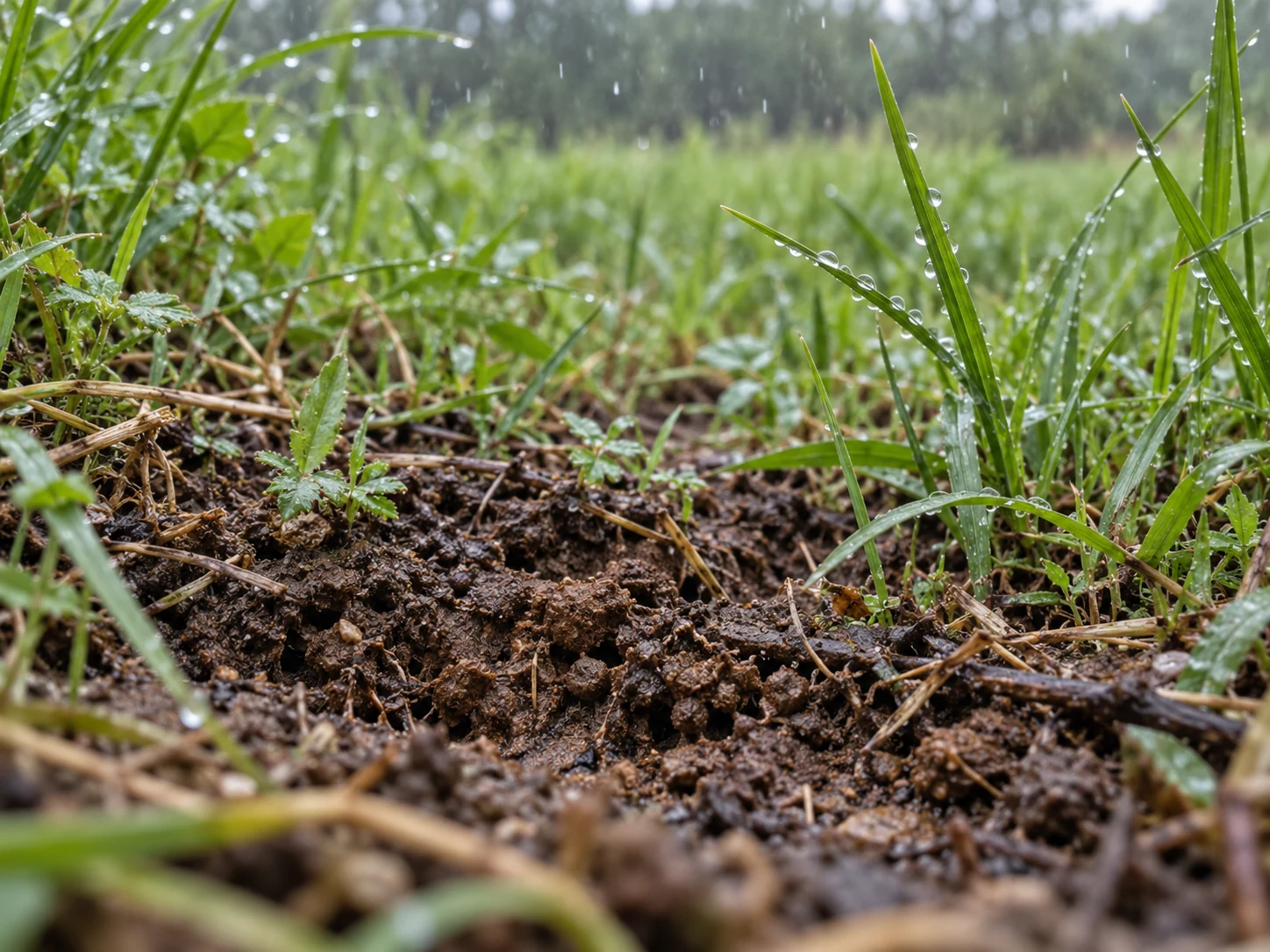
After a hard rain, one field may absorb water while another puddles or sheds runoff. This is why healthy soil is often compared to a sponge. The comparison is useful, but soil has two different jobs: letting rain enter and retaining water where roots can use it. [1]
Farming practices can influence both. The amount of change depends on the soil and the conditions, so there is no single water-storage improvement that applies to every field.
First, the rain has to get in
Infiltration is the entry of water into soil. Stable aggregates—the small clusters of soil particles—and connected pores give water routes below the surface. Roots and other channels help. A crusted surface or compacted ground can accept water more slowly than rain arrives, increasing ponding and runoff. [1, 2]
Plants and crop residue also soften the impact of raindrops and protect the surface. University of Minnesota Extension explains that organic matter and roots help create larger pores that move water and smaller pores that retain it. [6]
These are different improvements. More rain entering the root zone can be valuable even if the soil’s total storage capacity has not increased by the same amount.
Some stored water is easier for roots to reach
Soil texture—the balance of sand, silt and clay—strongly affects water behavior. Sandy soils generally drain quickly. Clay soils can hold considerable water, but some is held too tightly for plants to use. Medium-textured soils often offer a useful balance between drainage and available water. [8]
“Plant-available water” is the water held between field capacity, after excess water has drained, and the permanent wilting point, when plants can no longer extract enough. This is why measuring all the water in a soil does not tell you how much a crop can use. [8]
Organic matter influences soil structure and water retention. Its effect depends on the starting soil, rather than acting as an identical extra reservoir in every field. [1, 2]
What about the “1% organic matter” rule?
You may hear that increasing soil organic matter by one percentage point adds tens of thousands of gallons of storage per acre. Penn State Extension cites an NRCS estimate of more than 20,000 gallons. It is a rule of thumb, not a universal conversion. Soil depth, texture, starting organic matter, bulk density and the kind of water being measured all affect the answer. [4]
A 2022 USDA Agricultural Research Service study helps explain why context matters. It measured water properties in 266 soil samples under laboratory conditions and found strong relationships with organic matter and clay content. The response varied across the soils. The study examined laboratory water-holding properties; it did not test whether a farming change gave crops more usable water during a field drought. [3]
For a particular farm, repeated measurements of its own soil are more useful than multiplying an organic-matter increase by one fixed number of gallons.
Management changes how a field handles rain
Keeping soil covered, retaining roots, reducing unnecessary disturbance and managing compaction can influence water movement and retention. A 2018 NRCS literature review found mixed results for no-till when researchers measured available water-holding capacity. Residue, crop rotation, cover crops and the length of time under management also mattered. [5]
Grazing decisions can affect infiltration on grassland. A 2021 study of 52 ranches arranged in matched pairs in western Canada found higher infiltration under adaptive multi-paddock grazing than conventional management on neighboring ranches. Greater litter mass was also associated with better infiltration. Because it was an observational comparison, it cannot promise the same result whenever a farm changes its grazing system. [7]
Better soil still needs rain
Improved infiltration and retention can help plants use the rain that arrives. They cannot replace rainfall that never comes. A compacted layer can also prevent water from reaching deeper roots, limiting the value of improvements near the surface. [5]
Drought resilience means making better use of available water, not making a field drought-proof.
Useful evidence includes infiltration tests, soil-moisture measurements, organic-matter trends, ground cover and checks for compaction. These answer different questions and work best together. [1]
When a farmer checks a field after rain, the story is more than whether it looks wet. Where did the water go? How much ran off? How deeply did it reach? Those observations bring the idea of healthy soil down to something happening beneath the crop.
Sources and further reading
- Soil Health for Water Quality and Quantity. USDA Natural Resources Conservation Service.
- Role of Organic Matter. USDA Natural Resources Conservation Service.
- Soil organic matter, texture, and drying temperature effects on water content. Alan J. Franzluebbers · Soil Science Society of America Journal · 2022.
- Strategies to Improve Water Use Efficiency: Part 2. Penn State Extension.
- Effects on Soil Water Holding Capacity and Soil Water Retention Resulting from Soil Health Management Practices Implementation. USDA Natural Resources Conservation Service · 2018.
- Soil organic matter in cropping systems. University of Minnesota Extension.
- Adaptive multi-paddock grazing improves water infiltration in Canadian grassland soils. Döbert and colleagues · Geoderma · 2021.
- Understanding Soil Water Content and Thresholds for Irrigation Management. Oklahoma State University Extension.