
Learn / Living Land / Why Grow So Many Plants in One Pasture?
Living Land
Why Grow So Many Plants in One Pasture?
A pasture mixture can spread growth across the seasons, supply forage and change how nutrients cycle. The choice of plants matters more than the length of the seed list.
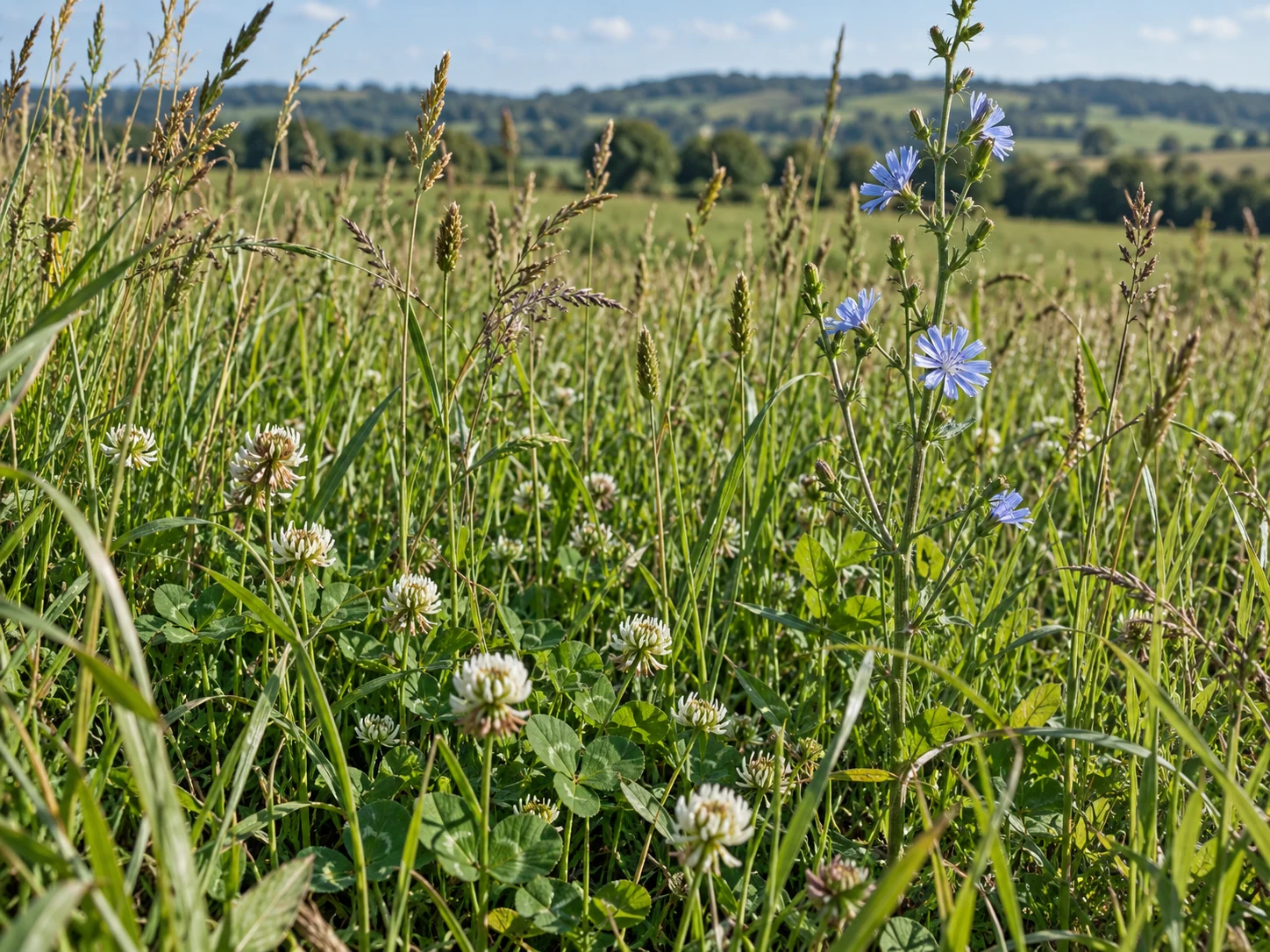
A pasture may contain grasses, legumes such as clover, and forage herbs such as chicory or plantain. The variety can look accidental. Sometimes it is a deliberate choice to combine plants with different jobs. [1, 2]
A useful mixture fits the soil, climate, animals and grazing season. It is not a contest to fit the most species into one field.
Different plants reach different places
Plant species differ in their roots, leaf shapes and growth patterns. A deeper-rooted plant may reach soil layers that another uses less. Plants also vary in their tolerance of heat, cold and wet conditions. [2, 3]
UF/IFAS forage specialists describe how plants can complement one another both below ground and across the seasons. University of Minnesota Extension similarly explains how grass-legume mixtures can share light, moisture and nutrients, and help maintain forage when one part of the mixture struggles. [2, 3]
These differences give farmers choices. They can select plants for the conditions they actually need to manage rather than expecting one species to perform equally well all year.
Clover brings a nitrogen partnership
Clovers and other legumes, including alfalfa and perennial peanut, form partnerships with compatible bacteria in root nodules. Together they can convert nitrogen from the air into forms the plant can use. [4]
That nitrogen does not simply pour into neighboring grass. It moves through plant growth, decomposing leaves and roots, manure, urine and soil organisms. Some is also lost from the system. Well-managed legumes can nevertheless reduce the need for purchased nitrogen fertilizer. [4]
In a long-running Florida grazing comparison, a grass-legume system received 30 pounds of fertilizer nitrogen per acre per year, compared with 200 pounds in the fertilized grass system. Animal gains were at least as great in the mixture. Those figures describe that Florida system; establishment costs, species persistence and management still mattered. [4]
A mixture can spread growth through the year
Plants do not all peak at the same time. Cool-season grasses grow most strongly in milder conditions. Warm-season species can contribute when cooler-season plants slow down. The value of a mixture includes when its plants grow, as well as how much they produce. [2]
Different responses can help spread risk. A 2022 review found that diversity could reduce vulnerability and improve drought resilience when plants had complementary traits. It did not suggest that any mixed pasture would be protected from drought. [5]
For a farmer, this is a question about the feed calendar: which plants will contribute when others are less productive?
What do grazing animals get from the mixture?
Forage plants differ in fiber, protein, digestibility, mineral content and palatability. The mixture can therefore change the feed available to animals, alongside the total amount of forage. [3]
A 2020 systematic review and meta-analysis compared pastures containing forage herbs with simpler grass or grass-legume pastures for dairy cows. Average milk production was about 1.2 kilograms higher per cow per day in the herb-containing mixtures. The finding came from a specific set of dairy studies, mostly outside the United States; it does not predict the response of every herd or establish that its milk is healthier. [6]
Keeping the mixture is part of the work
Planting a mixture does not freeze it in place. Weather, fertility, competition and grazing change which species thrive. Some plants can crowd out others; legumes may struggle where soil conditions are unsuitable. Establishment costs and weed management also need attention. [1, 3, 4]
A farmer may need to adjust grazing timing or other management as the plant community changes. The initial seed list is only the starting point.
A 2026 review of temperate pasture systems emphasizes selecting plants for their useful traits and compatibility, rather than simply increasing species numbers. A well-chosen small mixture can be more appropriate than a long list of plants that do not suit the site. [7]
The most interesting question about a diverse pasture is what each plant contributes: growth in another season, a nitrogen partnership, forage quality or a response to dry weather. Those details turn a green field into a picture of the farmer’s choices.
Sources and further reading
- Soil Health on Pastureland. USDA Natural Resources Conservation Service.
- Forage Diversification to Build Resilient & More Productive Pastures. UF/IFAS Extension · 2026.
- Benefits of legume-grass mixtures. University of Minnesota Extension.
- Sustainable Nitrogen in Livestock Systems: Forage Legumes vs. N Fertilizers. Trumpp and colleagues · UF/IFAS Extension · 2025.
- Using plant diversity to reduce vulnerability and increase drought resilience of permanent and sown productive grasslands. Lüscher and colleagues · Grass and Forage Science · 2022.
- Herb species inclusion in grazing swards for dairy cows—A systematic review and meta-analysis. McCarthy and colleagues · Journal of Dairy Science · 2020.
- Optimizing temperate pasture-based systems through strategic selection of forage plants. JDS Communications · 2026.