
Learn / Life on the Farm / Why Do Meat Chickens Grow So Fast?
Life on the Farm
Why Do Meat Chickens Grow So Fast?
Breeding changed the bird. Feeding and everyday care shape how that bird grows—and how comfortably it lives.
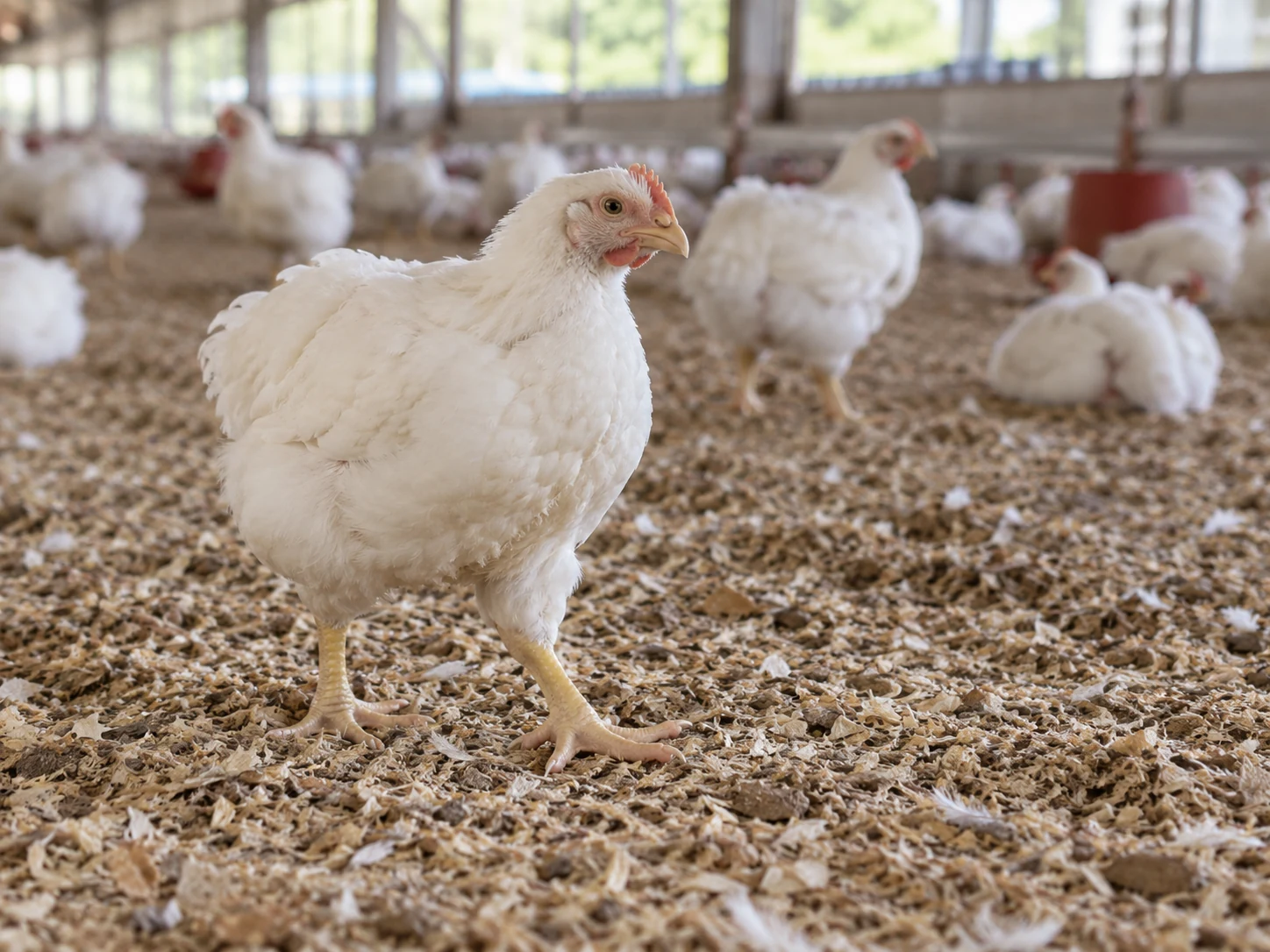
When a chicken breast nearly fills a dinner plate, it is reasonable to wonder how the bird got so big. Was it the feed? Added hormones? Or simply a different kind of chicken?
The main explanation is selective breeding, supported by nutrition and daily care. Meat chickens have been developed to grow quickly and use feed efficiently. But growth and a comfortable life are not the same thing. [2, 3]
The biggest change started before the farm
Meat chickens, often called broilers, are bred for meat production. Selecting parent birds for desired traits over generations changes what their offspring can do. Important traits include growth rate, feed efficiency, and breast-muscle yield. [1, 3]
In a study published in 2014, researchers raised 180 chicks from each of three lines: two preserved without commercial selection since 1957 and 1978, and a commercial line from 2005. All received the same contemporary feeding program and were followed to 56 days. [1]
The newer line grew much more and needed less feed per unit of weight gained. These were experimental comparisons, not a survey of every farm. But they show why a large broiler is not simply an old-fashioned chicken getting extra dinner. [1]
Feed and daily care still matter
A bird cannot build its body from breeding alone. University of Kentucky poultry guidance explains that prepared broiler feeds supply the nutrients growing chickens need, with formulations changing as the birds develop. Clean water, suitable temperatures, and adequate access to feeders also matter. [3]
Yet the same feed does not make every chicken grow alike. A University of Guelph study published in 2021 compared 7,528 birds from 16 genetic strains under standardized conditions. At 48 days, the conventional group was roughly 1.8–2.8 pounds heavier than the slower-growing groups. The birds shared the same feeding and management program. [2]
It is not a sign of added hormones
In the United States, hormones are not allowed in raising poultry. USDA says a “no hormones added” claim must be accompanied by a statement explaining that federal regulations prohibit their use. That claim does not distinguish a slower-growing chicken from a faster-growing one. [4]
An antibiotic claim answers a different question, too: whether the birds received antibiotics, not which strain they came from or how quickly they grew. Breed, medication, and living conditions should not be treated as interchangeable descriptions. [4]
What rapid growth can mean for the bird
Researchers assess welfare through walking tests and checks of skin condition—not just the number on a scale. [6]
A 2020 study compared 1,600 birds from three faster-growing breeds and one slower-growing breed, all housed indoors. The slower-growing birds were more active and had better walking scores and less hock burn, a form of skin damage around the joints above the feet. [5]
In that experiment, 26–37% of the faster-growing birds scored at least 3 on a walking scale running from 0 to 5, where higher scores mean greater impairment. The figure was 10% for the slower-growing birds. Those are study findings, not estimates for every chicken farm. [5]
The study received Farm Animal Welfare Forum funding through the RSPCA and used the RSPCA’s welfare protocol. The paper reports that funders did not collect or analyze the data. [5]
The results give consumers a reason to care about breeding. They do not support the claim that every fast-growing chicken is unable to walk.
A slower bird still needs good care
A 2022 analysis from the same University of Guelph research program examined mobility and skin health across 14 strains. The researchers concluded that both body weight and growth rate influenced walking ability, while wet litter was an important factor in skin lesions. Changing the bird does not remove the need to manage its surroundings. [6]
Nor does every welfare measure move together. The 16-strain study found no overall mortality difference between growth categories. Survival alone does not answer questions about movement or skin health. [2, 6]
Why slower growth can cost more
In the 2020 comparison, the slower-growing breed needed about two additional weeks to reach a similar weight and consumed more feed. Those extra inputs help explain why slower growth can cost more. [5]
What to look for when buying chicken
Look beyond a single reassuring phrase. For a slower-growth claim, useful information includes the named breed or strain, how the producer defines slower growth, and the age and weight at processing.
Then look for a separate explanation of daily care: space, bedding, opportunities for activity, and how health problems are handled. A growth-rate description is not a complete picture of the farm.
The goal is not simply a bird that takes longer to grow. It is a bird that can grow well and live well—and a producer willing to explain how both are being addressed.
Sources and further reading
- Growth, efficiency, and yield of commercial broilers from 1957, 1978, and 2005. M. J. Zuidhof and colleagues · Poultry Science · 2014.
- In pursuit of a better broiler: growth, efficiency, and mortality of 16 strains of broiler chickens. S. Torrey and colleagues · Poultry Science · 2021.
- Raising Meat Chickens in Small or Backyard Flocks. Jacquie Jacob, University of Kentucky · Poultry Extension.
- Meat and Poultry Labeling Terms. USDA Food Safety and Inspection Service · 2024.
- Slow and steady wins the race: The behaviour and welfare of commercial faster growing broiler breeds compared to a commercial slower growing breed. Laura M. Dixon · PLOS ONE · 2020.
- In pursuit of a better broiler: walking ability and incidence of contact dermatitis in conventional and slower growing strains of broiler chickens. M. N. Santos and colleagues · Poultry Science · 2022.