
Learn / Living Land / Is No-Till Farming Automatically Regenerative?
Living Land
Is No-Till Farming Automatically Regenerative?
Planting without plowing changes the soil’s disturbance. Crop choice, living roots, residue and weed management still shape the rest of the system.
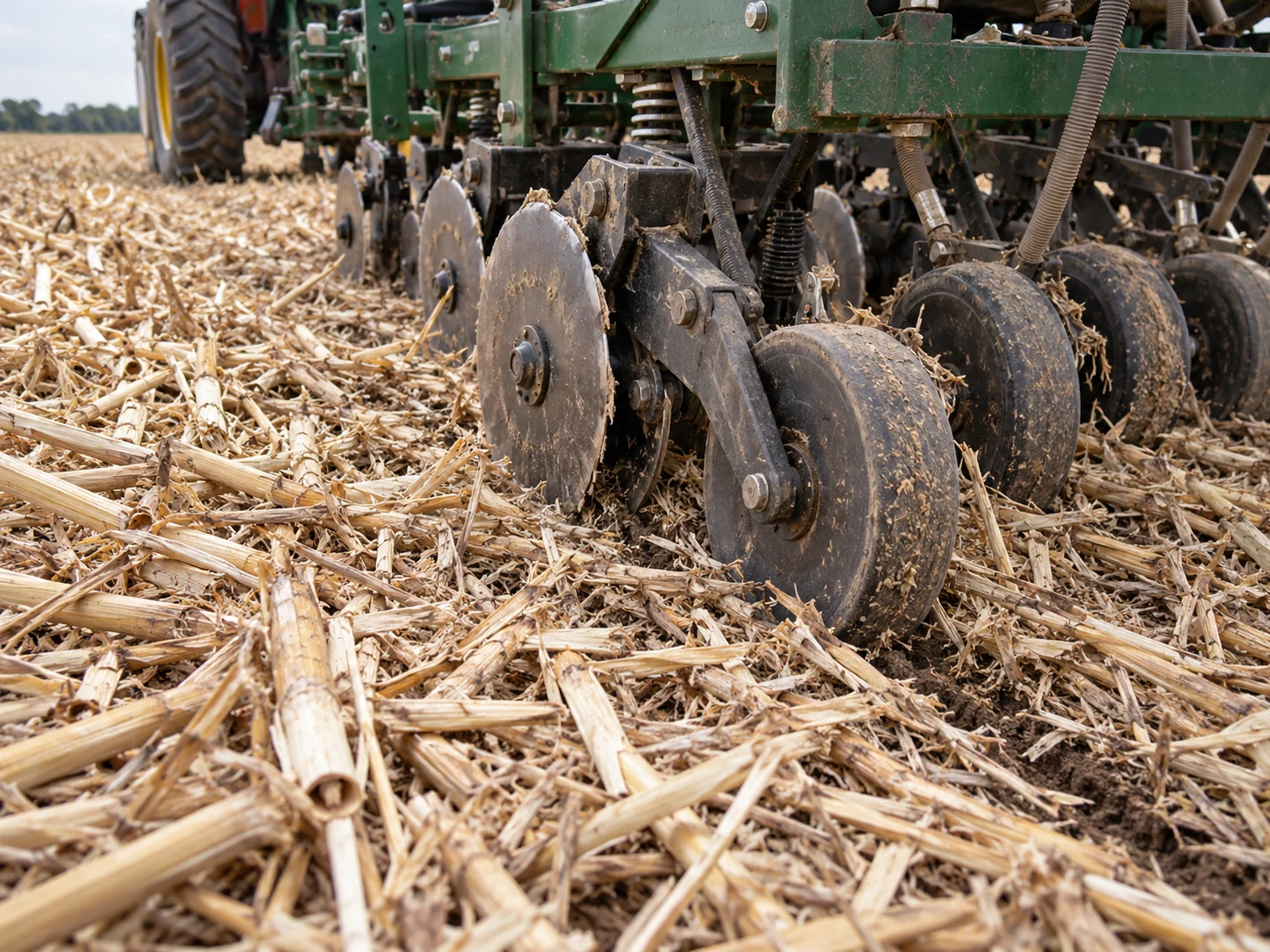
No-till can be an important conservation practice, but it describes one part of farming: how much the soil is mechanically disturbed. It does not tell you which crops grow, how weeds are controlled or whether the soil is improving. [1, 2]
A no-till field still needs a plan for everything that happens between harvest and the next crop.
Planting through what is already there
In a no-till system, farmers plant with little or no full-width soil disturbance. Instead of plowing the whole field first, specialized planters or drills place seed through residue left at the surface. [1]
Reducing tillage can protect soil structure and surface cover while cutting work and fuel associated with tillage. NRCS includes it among soil-health tools, alongside keeping the ground covered, maintaining living roots and increasing biodiversity. [1, 2]
The equipment has to place seed reliably through a less uniform surface. How the previous crop’s residue is spread becomes part of preparing for the next crop. [9]
What changes below the surface?
Tillage breaks soil aggregates, mixes residues and exposes organic matter that was physically protected. Reducing disturbance can help preserve pores and aggregates—the structures through which air, water and roots move. [1, 2]
A 2023 global meta-analysis found that no-till increased soil organic carbon concentration most strongly in the top five centimeters. Across the upper 30 centimeters, the amount of carbon stored was about 14% higher than under conventional tillage in the studies analyzed. Results varied with climate, soil texture, cropping system and time under no-till. [5]
The authors cautioned against treating no-till as a stand-alone climate solution. Much of the increase was near the surface, and their conclusion emphasized sustaining soil quality. The 14% comparison is neither an annual accumulation rate nor a predicted result for every field. [5]
The rotation still matters
Imagine two fields planted without plowing. One has a narrow crop rotation and long gaps without living plants. The other has a more varied rotation and cover crops between harvests. Both use no-till; their plant inputs and growing seasons differ.
That is why soil-health guidance combines practices. It is also why a review of regenerative definitions found a mixture of practice-based and outcome-based approaches rather than one universally agreed test. [1, 4]
Residue protects the surface, while living plants supply carbon compounds around growing roots. Cover crops can extend that living-root period where they fit the rotation. [2, 3]
A 2023 meta-analysis of 61 studies in rotations containing corn found that cover crops increased soil organic carbon stocks by an average of 7.3% over the study periods. The result depended on soil, climate, biomass and management. This is evidence for a separate planting decision, not a reason to give every no-till field the same cover crop. [6]
Weed control does not disappear
Without cultivation to uproot weeds, a farmer needs another strategy. Many conventional no-till systems use herbicides as part of that strategy. University of Minnesota Extension explains that reducing tillage can require changes to weed management. [8]
Organic approaches can include roller-crimping a cover crop to leave a surface mulch before planting. NRCS recognizes this as an organic no-till approach. It requires suitable crops and management; it is not an automatic substitute for every weed-control system. [7]
The term no-till alone therefore cannot establish whether a crop is organic or whether herbicides were used.
Residue changes the planting day
Retained residue can slow warming and drying in cool or poorly drained fields. Uneven residue can create differences in temperature, moisture and seedling emergence across the field. Penn State emphasizes both residue distribution and planter performance in successful no-till management. [9]
The farmer still has to judge the seedbed, check the equipment and decide when conditions are suitable. Removing a cultivation pass changes the work rather than removing the need to observe the field.
No-till is a useful detail in a farm’s story. Understanding it means following the rest of the season too: the crop rotation, surface cover, growing roots and weed-control plan. Together, those decisions explain much more than the absence of a plow.
Sources and further reading
- Soil Health on Cropland. USDA Natural Resources Conservation Service.
- Soil Health Management. USDA Natural Resources Conservation Service.
- Cover Crops for Soil Health. USDA Natural Resources Conservation Service.
- What Is Regenerative Agriculture? A Review of Scholar and Practitioner Definitions Based on Processes and Outcomes. Newton and colleagues · Frontiers in Sustainable Food Systems · 2020.
- No-till is more of sustaining the soil than a climate change mitigation option. Mondal and colleagues · Agriculture, Ecosystems & Environment · 2023.
- A global meta-analysis of cover crop response on soil carbon storage within a corn production system. Joshi and colleagues · Agronomy Journal · 2023.
- Healthy Soils — NRCS Assistance for Organic Farmers. USDA Natural Resources Conservation Service.
- Reducing tillage intensity. University of Minnesota Extension.
- Residue Distribution Critical for No-Till Success. Penn State Extension · 2026.