Learn / Living Land / What Does Regenerative Agriculture Actually Mean?
Living Land
What Does Regenerative Agriculture Actually Mean?
Start with the living soil, then ask what a farm is doing and how it will measure change.
The short version
A useful regenerative story connects a practice, its purpose and evidence of what changed.
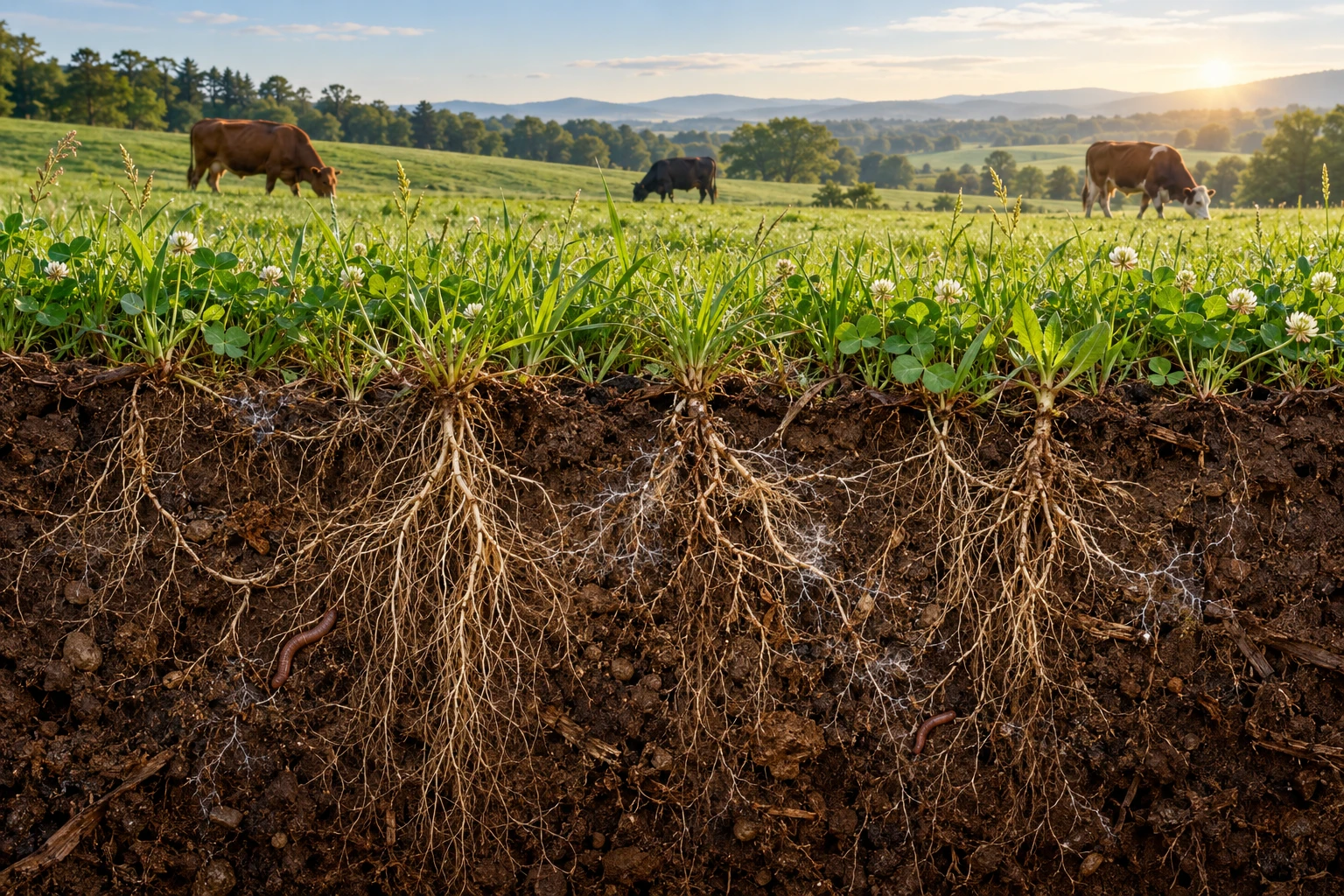
Stand at the edge of a pasture and the first thing you see is grass. The more interesting story includes the roots, the water moving through the ground and the organisms living underneath.
Regenerative agriculture is an approach to farming that aims to improve the functioning of soil and the wider farm ecosystem. The term does not describe one agreed recipe. A 2020 review found definitions based on practices, intended outcomes, or both. That makes two questions essential: what is being done, and what is actually improving?
Begin below the surface
Soil is a living system involved in nutrient cycling, water regulation and plant growth. USDA NRCS emphasizes keeping living roots, maintaining soil cover, supporting diversity and managing disturbance. These principles help explain why the condition of the ground matters alongside what grows above it. Explore soil health with NRCS.
- Cover protects the surface. Plants and plant residue help shield soil from erosion.
- Roots support life below ground. Living roots provide food for soil organisms involved in nutrient cycling.
- Recovery gives plants time to regrow. Grazing decisions need to account for plant condition, moisture and the season.
These are reasons to investigate a practice, not proof that a particular farm has improved. The result still needs to be measured.
Recovery is part of the grazing plan
NRCS describes pasture management as a balance of grazing intensity, timing and recovery. Repeated overgrazing can reduce infiltration and increase runoff. Appropriate recovery depends on conditions such as moisture and the growing season; a fixed calendar alone cannot describe every pasture. Read the pastureland guidance.
For a shopper, the useful question becomes: how does the farmer decide when to move animals and when to return? We would rather see that decision explained than a diagram that suggests the same rotation works everywhere.
What would make progress visible?
We would ask a farm story to identify the starting condition, the change in management, the measurement used and the time period. A dated comparison from the same place is more informative than two unrelated photographs labeled “before” and “after.”
Ask what did not improve, too. If a report discusses one outcome, look for its boundaries. Does it cover one field or an entire operation? Does it describe a practice being adopted, or a result actually measured? Those are different kinds of evidence.
Our intention for Simply Pasture
We want care for land to be visible in the food story. Our program is still being developed, and we are not reporting measured environmental gains from Simply Pasture farms. The current Impact page explains our priorities and the questions we intend to keep asking.
Explore our approach to impact →
Explore the practices in more detail: soil cover, the role of livestock and no-till farming.
Sources
- What Is Regenerative Agriculture? — Newton and colleagues, Frontiers in Sustainable Food Systems, 2020
- Soil Health — USDA Natural Resources Conservation Service
- Soil Health on Pastureland — USDA Natural Resources Conservation Service