
Learn / Life on the Farm / Why Do Pasture-Raised Hens Still Need Feed?
Life on the Farm
Why Do Pasture-Raised Hens Still Need Feed?
Pasture gives hens room to forage. Balanced feed helps meet needs a field cannot reliably supply.
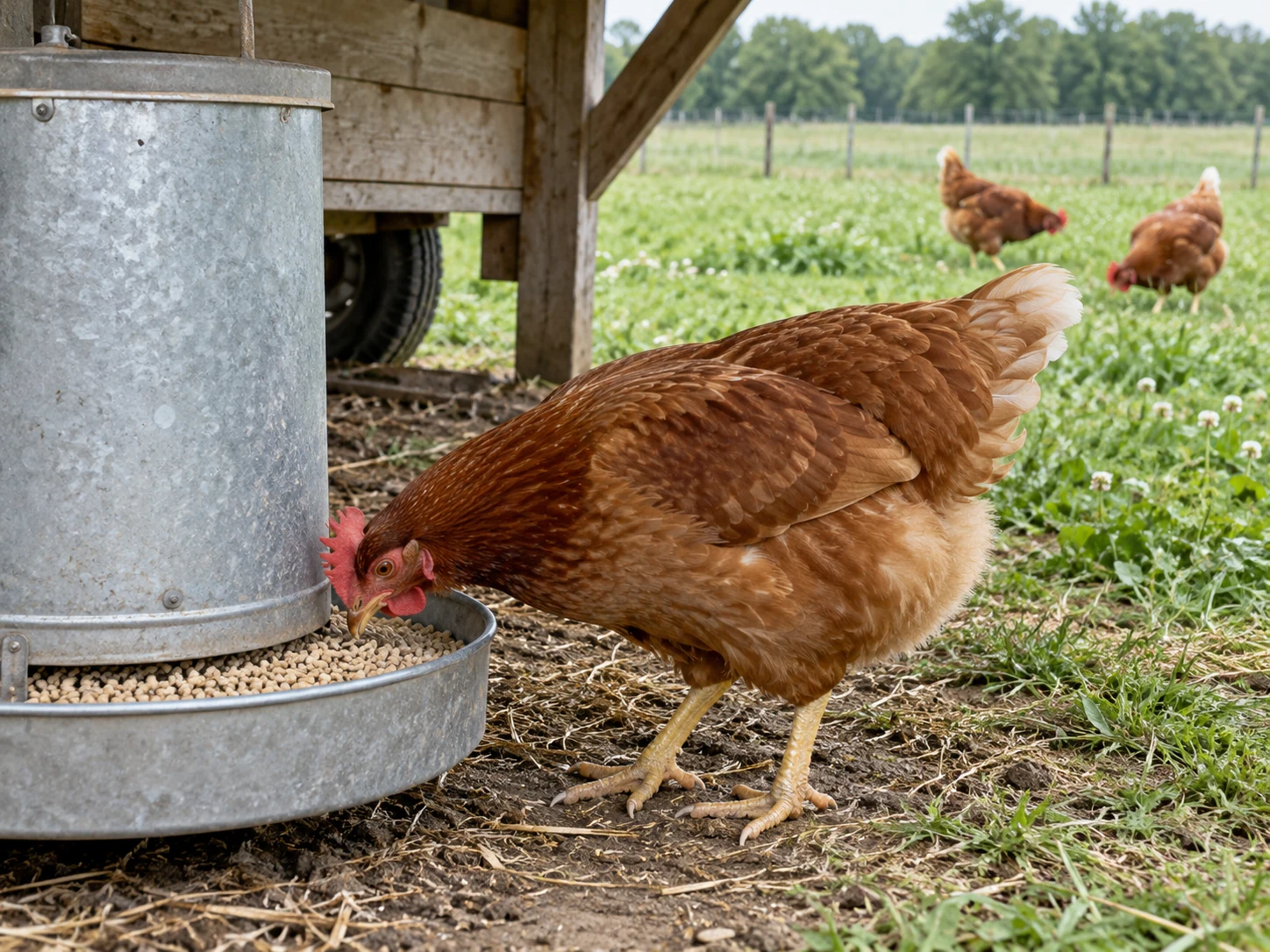
A hen is scratching through a field, pecking at plants and searching for insects. Nearby, there is a feeder.
Isn’t that a contradiction? If she is pasture-raised, shouldn’t she be finding all her own food?
Not necessarily. Pasture can contribute to a hen’s diet, but it is not a dependable replacement for a balanced feeding program. Raising chickens on pasture and providing them with prepared feed can be complementary parts of caring for the same flock. [1]
The distinction starts with understanding what a chicken actually eats.
Chickens don’t eat like cattle
Chickens are omnivores. Their diet can include grains, seeds, leafy plants, insects, and other small creatures. Eating grain is not, by itself, a sign that something has gone wrong with their care. University of Minnesota Extension includes grains among the foods chickens eat and recommends a prepared feed balanced for their nutritional needs. [2]
But chickens are not grazing animals in the same sense as cattle. They do not have the digestive system that allows ruminants to make such effective use of fibrous forage. Rodale Institute’s guidance on pastured poultry explains that chickens cannot efficiently digest cellulose—the structural material in plant cell walls—and cannot rely on pasture alone. [1]
So a hen pecking her way across a field is doing something different from a cow grazing beside her. The setting may look similar. Their nutritional needs are not.
What’s in the feeder—and why?
Prepared feed is meant to supply a predictable combination of nutrients, rather than leave the hen’s entire diet to whatever she finds that day.
Corn, for example, provides digestible energy. Soybean meal can complement a corn-based diet by supplying more of the amino acids that corn provides in smaller amounts. Their presence in feed has a nutritional purpose; the ingredient names alone do not tell us whether a hen lives indoors or on pasture. [3]
The complete mixture matters, too. A feed formulated for laying hens is not the same thing as a handful of cracked corn or mixed scratch grains. Penn State Extension cautions that those grains are not a complete diet on their own. Adding too much to a complete feed can dilute its nutritional balance rather than improve it. [4]
Calcium is another important part of the picture. A laying hen needs it for both bone strength and eggshell quality—not just to keep producing eggs for us. Humane Farm Animal Care’s laying-hen standards specifically address both needs. [5]
That is an important way to think about feeding: the goal is a well-nourished bird, not simply a productive one.
How much food can a hen find on pasture?
The words “pasture-raised” do not tell you what percentage of a hen’s nutrition comes from foraging.
What is growing matters. University of Kentucky poultry guidance describes young, tender plants as useful sources of nutrients, while noting that chickens cannot digest old, fibrous plants well. Pasture can reduce the amount of prepared feed needed, but a field’s appearance does not tell us how much nutrition each hen is actually getting. [6]
The season matters as well. During winter, there may be fewer insects and seeds available. At the same time, chickens can need more feed in cold weather to help maintain their body temperature. A feeding plan needs to account for the birds’ circumstances, not just the amount of land around them. [2, 7]
For shoppers, that means a photograph of green pasture is only part of the story. It cannot tell you whether the flock’s whole diet is adequate.
A useful lesson from pasture research
A six-week study published in 2010 helps illustrate why feed still matters.
Researchers compared eggs from 75 hens rotated through different pastures with eggs from 50 caged hens. The pastured birds received a measured amount of commercial feed every day; they were not living on grass and insects alone. At the end of the experiment, the pastured hens weighed less and had lower egg production than the caged comparison birds. The authors emphasized the importance of supplying enough dietary energy and protein to hens on pasture. [8]
Those findings describe that particular experiment, not every pasture-based farm. They also do not establish that housing alone caused the differences, because the feeding arrangements differed.
The practical lesson is that outdoor access does not remove the need to manage nutrition. Pasture and a suitable feeding program have to work together.
Then what does pasture add?
A hen’s environment matters for reasons beyond the food she finds there.
An outdoor area can offer room to explore, scratch, forage, and dust-bathe. But making that space useful requires care: vegetation, shelter, protection from predators, and attention to worn or muddy ground.
For example, Humane Farm Animal Care’s Edition 21 standards for its Certified Humane pasture-raised system require living vegetation, pasture rotation, shade, cover, and suitable housing. The same document also requires a diet formulated to meet the hens’ nutritional needs. These are requirements of that particular certification—not a promise made by every carton using the words “pasture-raised.” [5]
That combination is the point. A balanced diet does not replace an appropriate living environment. An appropriate living environment does not replace a balanced diet.
What this means when you buy eggs
Don’t dismiss pasture-raised eggs simply because the hens also eat grain. But don’t assume a pasture claim tells you everything about their feed, either.
Look for two separate explanations from the producer: how the hens live and how they are fed. A published pasture standard can describe outdoor conditions and management. Feed information can explain the ingredients and how the flock’s nutritional needs are met.
A feeder is not evidence that pasture-based farming is fake. Nor is a grassy field, by itself, proof of good care.
The more useful picture includes both: hens with a suitable place to live and forage, and a feeding program that keeps them properly nourished.
Sources and further reading
- How to Establish a Small-Scale, Pastured Poultry Operation — Rodale Institute · 2012.
- Raising chickens for eggs — University of Minnesota Extension · Reviewed 2025.
- Corn in Poultry Diets — Jacquie Jacob, University of Kentucky · Poultry Extension.
- Prevention of Egg Eating in Chickens — Penn State Extension · Updated 2023.
- Animal Care Standards: Egg Laying Hens, Edition 21 — Humane Farm Animal Care.
- Feeding Chickens for Egg Production in Small and Backyard Flocks — Jacquie Jacob, University of Kentucky · Poultry Extension.
- Chicken feed during non-laying winter months — James Hermes · Ask Extension · 2015.
- Vitamins A, E and fatty acid composition of the eggs of caged hens and pastured hens — Karsten, H. D.; Patterson, P. H.; Stout, R.; Crews, G. · Renewable Agriculture and Food Systems · 2010.