
Learn / Life on the Farm / What Happens During the Feedlot Stage of Beef Production?
Life on the Farm
What Happens During the Feedlot Stage of Beef Production?
Arrival, feeding, health care and manure management are parts of the finishing stage. They are not the animal’s whole story.
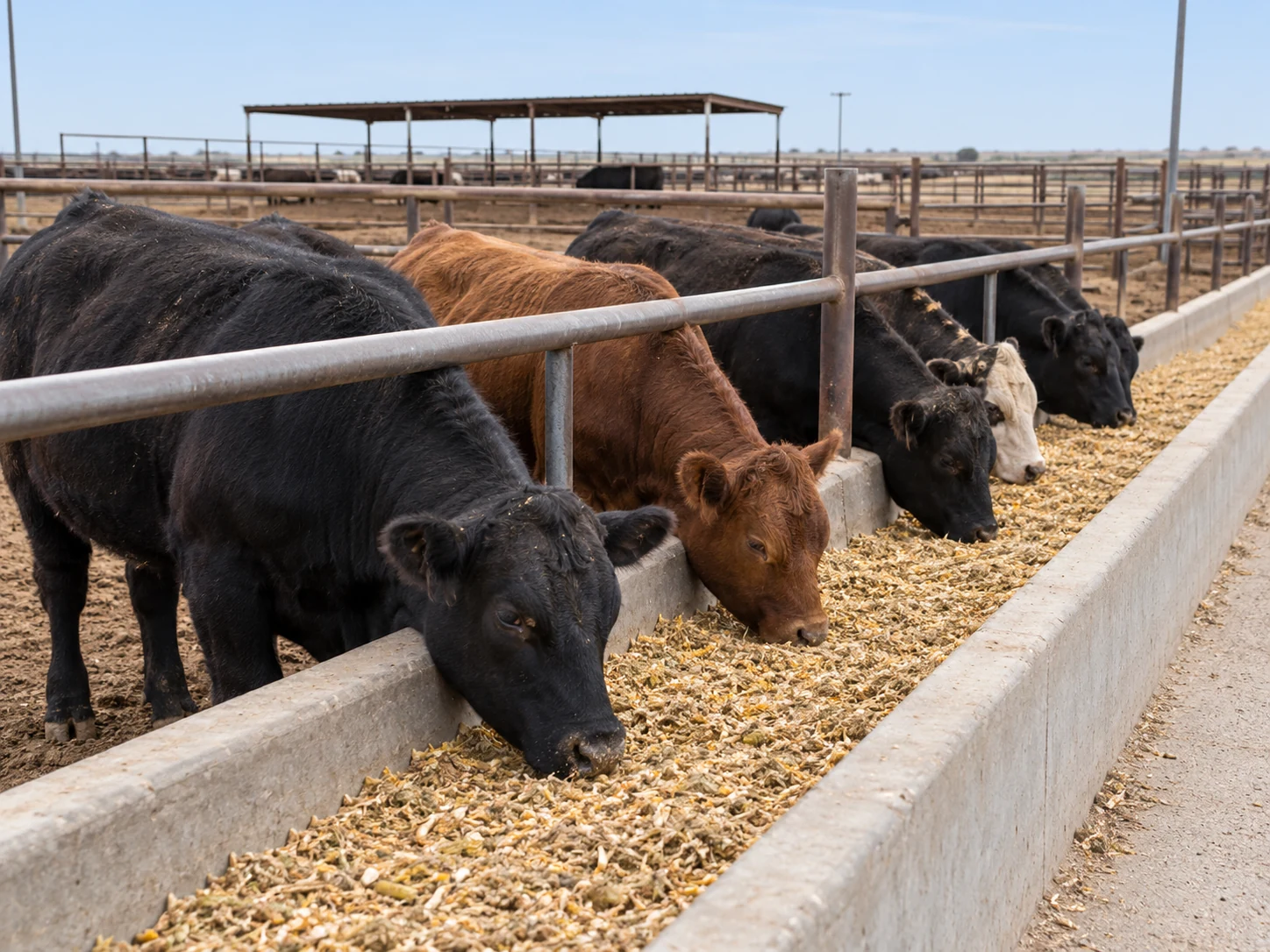
Drive past a large feedlot and it can look like the entire story of a beef animal: rows of cattle, feed bunks and open pens. In most U.S. beef systems, though, the feedlot is a finishing stage – not the animal’s whole life. Cattle commonly begin in a cow-calf operation and may spend additional time in a stocker or backgrounding program before entering a feedlot. [1, 2]
That distinction matters because words such as feedlot, grain-fed, grass-fed and CAFO describe different things. One refers to a production stage, another to diet, and another is a regulatory category. Understanding what happens during the finishing stage makes those labels much easier to interpret.
The feedlot usually comes near the end
USDA’s Economic Research Service broadly divides the U.S. beef industry into cow-calf production and cattle feeding. USDA’s 2021 national feedlot study found that, among cattle brought in from outside the feedlot operation, slightly more than half came directly from a cow-calf, stocker or backgrounding operation, while a large share also arrived through sale barns. [1, 2]
USDA uses “days on feed” for the period from placement in a feedlot until the animal leaves for slaughter. There is no single universal number. Starting age, weight, genetics, health, diet, weather and the target market can all change how long an animal remains on feed. [2]
That is why a statement such as “feedlot cattle spend five months there” can be true for a particular group without being a definition of feedlot beef generally.
Feedlot and CAFO are not the same word
People often use feedlot and CAFO interchangeably, but the terms are not identical. Under EPA rules, an animal feeding operation is a facility where animals are confined and fed or maintained for at least 45 days in a 12-month period and where vegetation is not sustained over the confinement area during the normal growing season. A concentrated animal feeding operation, or CAFO, is an animal feeding operation that also meets additional regulatory criteria. [3]
So “feedlot” describes a type of cattle-feeding system. “CAFO” is a Clean Water Act regulatory category. The distinction becomes important when discussing manure, runoff and permitting.
Arrival is more than opening a gate
Moving cattle from one operation to another can be stressful, and animals from different sources may arrive with different vaccination and health histories. USDA notes that preconditioning before shipment can include vaccination, castration, dehorning when needed, deworming and teaching calves to eat from a bunk and drink from a water tank. [2]
At the feedlot, arrival processing can include identification, health assessment, vaccinations, parasite treatment and other procedures appropriate to the cattle. Antibiotics may be used for disease treatment, control or prevention in some situations, but that does not mean every animal entering a feedlot automatically receives an antibiotic. In USDA’s 2021 feedlot study, most feedlots reported using a veterinarian. [2]
The diet changes gradually
The common picture of cattle moving from grass straight to a pile of corn misses an important part of feedlot nutrition: adaptation.
Finishing diets are energy-dense, but they still contain more than grain. Oklahoma State University describes contemporary finishing rations as potentially including cereal grains, roughage such as hay or silage, protein and mineral supplements, and by-product feeds such as distillers grains or corn gluten feed. The exact proportions vary by ration and available ingredients. [4]
Cattle are normally stepped up from a higher-roughage diet toward the final higher-concentrate ration over a period of weeks. That transition helps the rumen adjust and lowers the risk of digestive problems such as acidosis. Even final finishing diets generally retain some roughage for rumen health. [4]
Why use a feedlot at all?
The basic reason is controlled finishing. A high-energy ration can support faster weight gain and more efficient conversion of feed into body weight than a lower-energy forage diet. Feedlots also allow nutrition, feed delivery and groups of cattle to be managed in a relatively consistent way. [1, 4]
There is a tradeoff: increasing dietary energy and rapidly fermentable carbohydrate makes feed management more important, not less. The goal is not simply to provide as much grain as possible; the ration has to balance energy, roughage, protein, minerals and animal health.
Antibiotics and growth implants are different tools
Two practices that are often grouped together by consumers are actually different. Antibiotics are drugs used to address bacterial disease. USDA notes that medically important antibiotics can no longer be used for growth promotion in food-producing animals, and their use in feed or water requires veterinary oversight under current federal policy. [2]
Growth-promoting ear implants are a separate category. FDA has approved certain steroid hormone implants for beef cattle to increase growth rate and feed efficiency. They are placed under the skin of the ear and must be used according to the approved label. Not every beef program uses implants, and “no added hormones” is a separate production claim that must be supported when it appears on a meat label. [5, 7]
The manure is concentrated too
When animals graze, manure is deposited across the landscape. In a feedlot, feed and cattle are concentrated in one location, so manure is concentrated there as well. That creates a different management problem.
Open lots can require scraping, drainage, runoff controls, storage and planned land application of manure nutrients. EPA requires nutrient-management planning for CAFOs covered by its permitting rules. Pen conditions can change substantially with weather, drainage, stocking and maintenance, which is why a single photograph is a poor substitute for understanding how a particular feedlot is managed. [3, 6]
What the label can – and cannot – tell you
A feedlot tells you something about where cattle were finished. A grain-fed claim tells you something about diet. A “no antibiotics” or “no added hormones” claim tells you about a treatment protocol. Those are separate questions.
USDA FSIS evaluates animal-raising claims such as grass-fed, raised without antibiotics and pasture-raised based on supporting documentation. A diet claim by itself does not describe every housing condition the animal experienced, and a housing description does not automatically tell you the complete diet. [7]
For consumers who want more transparency, useful questions are: Where did the cattle spend the earlier part of their lives? What was the finishing diet? How long were they in confinement? Were growth implants used? How were sick animals treated? How was manure managed?
The feedlot stage is only one chapter in the animal’s production history. Understanding that chapter is more useful than treating “feedlot,” “grain-fed” or “grass-fed” as shorthand for the entire way an animal was raised.
Sources and further reading
- Cattle & Beef. USDA Economic Research Service.
- Management Practices on U.S. Feedlots, 2021. USDA APHIS, National Animal Health Monitoring System · 2024.
- Animal Feeding Operations (AFOs). U.S. Environmental Protection Agency.
- Finishing Beef Cattle On The Farm. Oklahoma State University Extension.
- Steroid Hormone Implants Used for Growth in Food-Producing Animals. U.S. Food and Drug Administration.
- Understanding Nutrient Management Plans. U.S. Environmental Protection Agency.
- FSIS Guideline on Substantiating Animal-Raising or Environment-Related Labeling Claims. USDA Food Safety and Inspection Service · 2024.